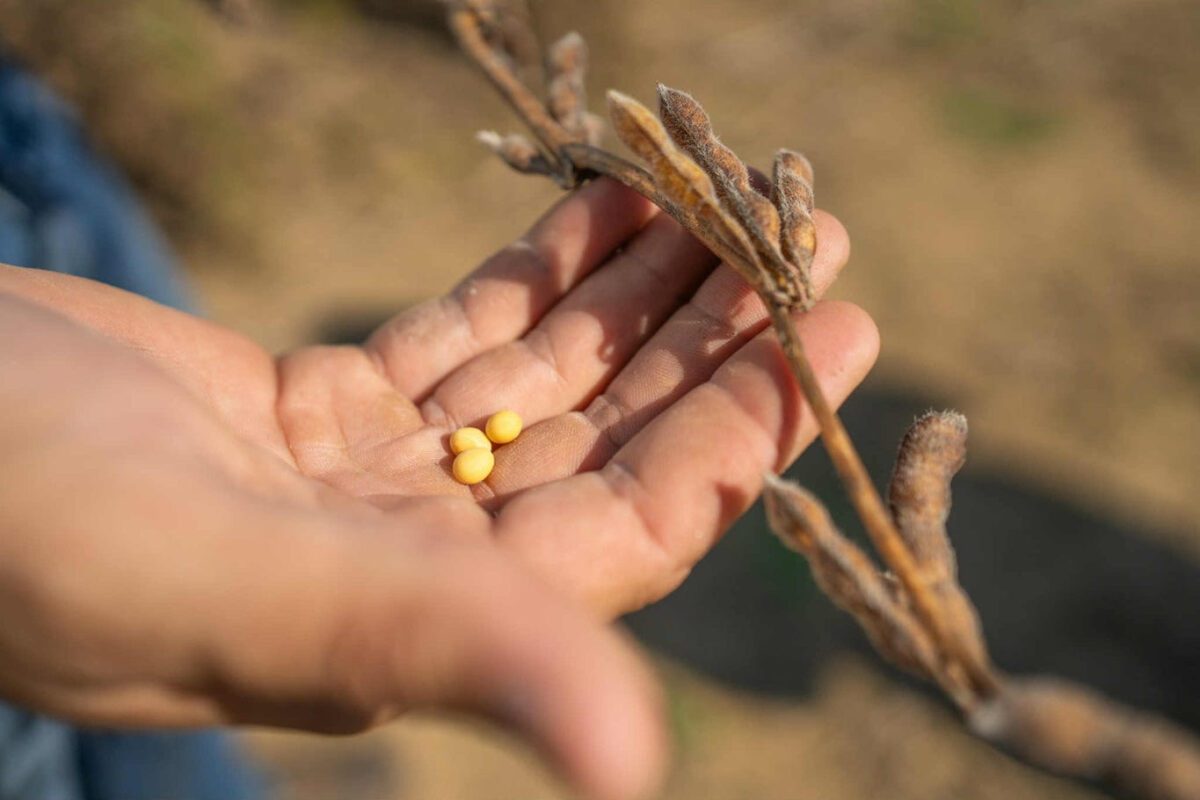
Johnny Verell of Verell Farms inspects his soybean crops in Jackson, Tennessee. (USA Today via Reuters Connect)
After a tense months-long standoff over tariffs, China has agreed to resume U.S. soybean imports in exchange for the U.S. easing up its tariff policy.
As part of the Oct. 30 agreement, China committed to buying 12 million metric tons of U.S. soybeans in the last two months of 2025 and at least 25 million tons the next three years. While the deal would provide some relief to Wisconsin’s 16,000 soybean farmers, who produce about $1.3 billion worth of soybeans every year, experts say it might not be enough after months of tariff uncertainty.
While China will suspend retaliatory tariffs placed on U.S. imports from Nov. 10, including tariffs up to 15% imposed on some imported U.S. farm goods, the nation will keep 10% levies introduced in response to Trump’s tariffs, and U.S. soybeans will still face a 13% tariff.
China imports three-fifths of all the soybeans traded on international markets, but since late May the country has boycotted the purchase of American soybeans in response to President Donald Trump’s tariffs. Midwest states, which produce most of the country’s soybeans, were hit the hardest by the boycott.
Soybeans are the second-largest crop in Wisconsin, and the state exports roughly two-thirds of their crop annually. Most of the state’s soybeans are exported to China, Canada and Mexico, according to the Wisconsin Soybean Association.
This year, Wisconsin farmers planted an estimated 2 million acres of soybeans, with 1.97 million acres to be harvested, according to the Wisconsin Department of Agriculture, Trade and Consumer Protections. The soybean production is expected to yield 104 million bushels, up 3% from 2024.
Here’s what to know about the new trade deal between China and the U.S. and what it means for U.S. soybean exports.
2025 U.S. soybean exports to China will come below average despite new deal
Soybeans are a top food export for the U.S., making up 14% of the nation’s agricultural exports, according to the U.S. Department of Agriculture. In 2024, China bought $12.5 billion of the $24.5 billion of soybeans the U.S. exported globally — more than 50% of U.S exports of the crop.
In 2024, China imported approximately 26.8 million metric tons of U.S. soybeans, according to the Center for Strategic and International Studies. But even with China’s commitment to purchasing 12 million metric tons before the end of 2025, total U.S. soybean exports to China this year would only reach 18.2 million metric tons — a 32% decline in exports since 2024.
China’s boycott of U.S. soybeans has cost farmers billion of dollars in lost exports. While the recent deal will help make up for some loss ground, a decrease in U.S. soybean exports to China paired with high production costs and low crop prices have made 2025 a tough year for American farmers.
Additionally, the 25 million tons of U.S. soybeans China agreed to buy annually for the next three years falls short of the average amount sold to China since the COVID-19 pandemic. From 2020 through 2024, the U.S. sold an average of more than 28 million metric tons of soybeans to China annually, according to the Center for Strategic and International Studies.
Tariff uncertainty makes it hard for US farmers to plan ahead, expert says
University of Wisconsin-Madison professor and chair of the Department of Agricultural and Applied Economics Paul Mitchell told the Milwaukee Journal Sentinel the “randomness” of the Trump administration’s trade policy has put additional stress on producers in the U.S. who are struggling to plan ahead due to economic uncertainty.
“You don’t invest millions in domestic production based off of something that can change that fast so a lot of companies are just waiting until it is clear what exactly the trade policy is and how long it will last,” Mitchell said.
In Wisconsin, grain farmers will likely face negative margins in 2025 as expected prices for corn and soybeans are below the estimated break-even points for producers, according to projections by the UW-Madison Extension. Many soybean producers have already started selling at a lower prices while waiting for Trump to strike a deal with China.
In 2025, American Relief Act provided over $30 billion to the U.S. Department of Agriculture for two major farm relief programs: the Emergency Commodity Assistance Program and the Supplemental Disaster Relief Program. While both programs aimed to reverse significant income losses for grain producers, a January 2025 analysis by the University of Illinois concluded the aid would likely not be enough if commodity prices do not increase in 2025.
Federal bailout for farmers still in the works but it may not come fast enough, industry experts say
While Trump said he hopes to use some of the money raised by his tariffs and “give it to our farmers,” it may not come fast enough for some agriculture producers in the U.S. as the federal government shutdown continues to hold up the the aid package.
Joe Maxwell, co-founder and president of Action Farm Fund, a nonpartisan, farmer-led government watchdog group, told the Journal Sentinel time is running out to finalize an aid package as farmers begin to make decisions about next year’s planting season. Farmers don’t have time to wait for the planned $12 billion in aid, Maxwell said.
“They have not indicated where they’re getting that money… but we’re already starting to plan 2026, and the structure looks just the same,” Maxwell said. “(Farmers) are living this on the ground, and we see it. This system is broken.”
Maxwell said U.S. agriculture has been struggling for sometime, and while bailouts are meant to help farmers, they really only lift some financial burdens in the short run.
One downfall of government bailouts is that the extra income can inflate land prices. Maxwell said aid can inadvertently end up costing farmers more over time and sometimes results in a “horrible cycle” where farmers become dependent on government aid when its intended purpose is to provide short term assistance.
“We’re constantly throwing a little more money at farmers to get them through one more year, and we’re not addressing the overall problem,” Maxwell said. “This system doesn’t work. Before the trade war, farmers had to come in and ask for money. Somebody needs to start talking about what we’re going to do structurally.”
Anna Kleiber can be reached at [email protected].
This article originally appeared on Milwaukee Journal Sentinel: China has resumed U.S. soybean imports. It might not be enough for Wisconsin farmers
Reporting by Anna Kleiber, Milwaukee Journal Sentinel / Milwaukee Journal Sentinel
USA TODAY Network via Reuters Connect
Author


Bird flu found for first time in Wisconsin after Dodge County dairy herd tests positive
Since the first cases of bird flu were confirmed in dairy herds in Texas and Kansas in March 2024, Wisconsin had been among a handful of states...

Retired veterinarian uses pasture for seasonally grazing dairy heifers and extra income
BEAR CREEK, Wisconsin – Earlier this year Jeff and Alex Wepner were looking for a place where their dairy heifers could grow and develop during the...
China is boycotting American soybeans. Wisconsin farmers will pay the price for it, trade group says
As China and the U.S. remain locked in a tense standoff over tariffs, Wisconsin soybean farmers have found themselves in the crossfire of the...

In Portage County, residents fight for a say in local government
One of my favorite photos of my friend Jason Dunkin is a selfie he took where he’s grinning ear to ear. He’s sitting across from his local city...