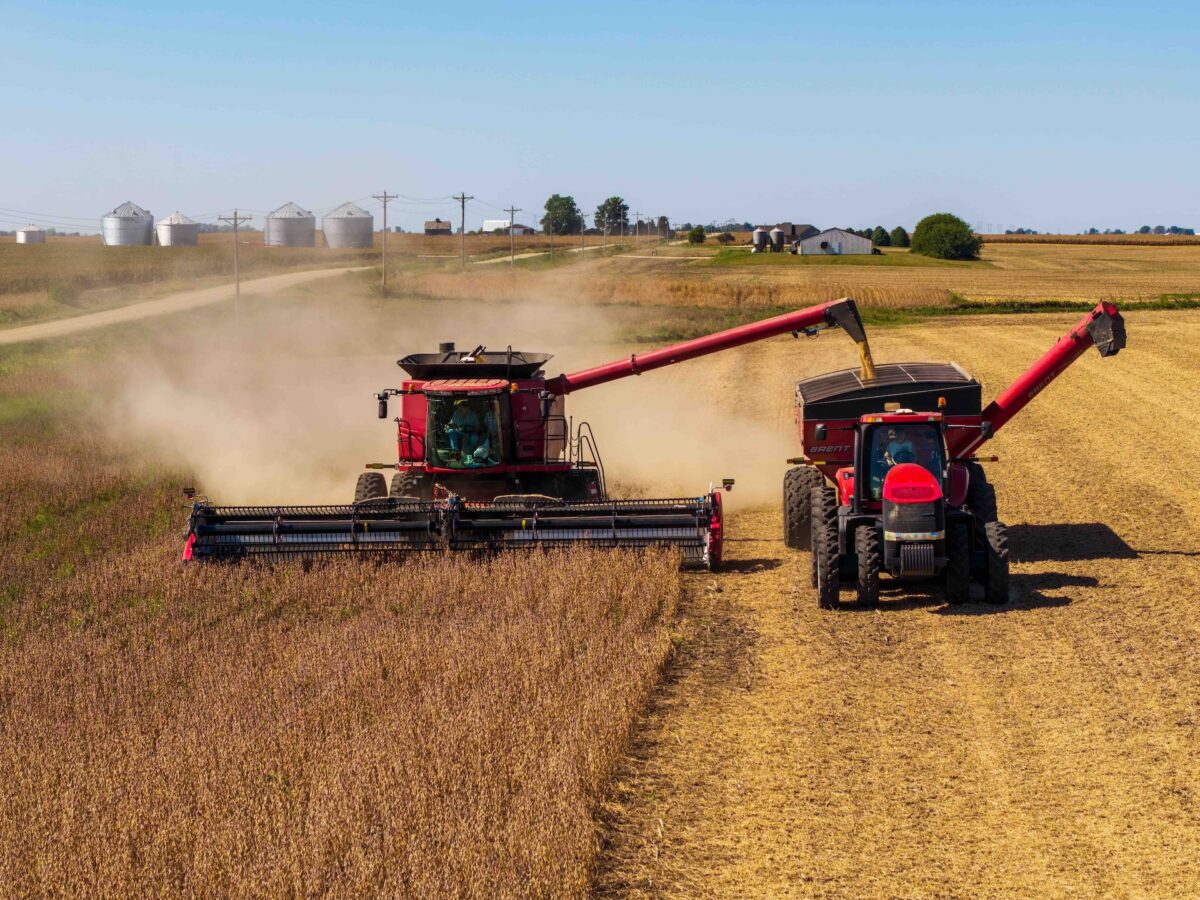
David Weaver harvests soybeans from a field near Rippey, Sept. 25, 2025. (USA Today via Reuters Connect)
As China and the U.S. remain locked in a tense standoff over tariffs, Wisconsin soybean farmers have found themselves in the crossfire of the dispute as they begin to harvest this year’s crop.
China imports three-fifths of all the soybeans traded on international markets but since late May, the country has boycotted the purchase of American soybeans in response to President Donald Trump’s tariffs. Midwest states, which produce most of the country’s soybeans, are feeling the impact — and could be for years to come.
Here’s what to know about Wisconsin’s soybean industry, U.S. soybean exports and how tariffs are affecting American farmers.
A breakdown of Wisconsin’s soybean industry, crop outlook for 2025
Wisconsin’s 16,000 soybean farmers produce about $1.3 billion worth of soybeans every year, exporting roughly two-thirds of its crops annually.
Soybeans are the second-largest crop in Wisconsin. In 2024, farmers in the state harvested 102 million bushels of soybeans, according to the state Department of Agriculture, Trade and Consumer Protection. Most of the state’s crop is exported to China, Canada and Mexico, according to the Wisconsin Soybean Association.
This year, Wisconsin farmers planted an estimated 2 million acres of soybeans, with 1.97 million acres to be harvested, according to DATCP. The soybean production is expected to yield 104 million bushels, up 3% from 2024.
In 2024, Midwest states dominated U.S. soybean production, with Illinois leading the nation in nearly 699 million bushels produced.
China boycotts American soybeans over tariffs; farmers will pay the price, American Soybean Association says
Soybeans are a top food export for the U.S., making up 14% of the nation’s agricultural exports, according to USDA.
Once the largest buyer of American soybeans, China has not purchased a single shipment since May, according to USDA data. In 2024, China bought $12.5 billion of the $24.5 billion of soybeans the U.S. exported globally — more than 50% of U.S exports of the crop.
But for the first time in years, American soybean famers have begun to harvest their crop with no purchase orders from China.
“The further into the autumn we get without reaching an agreement with China on soybeans, the worse the impacts will be on U.S. soybean farmers,” the American Soybean Association said in an Aug. 19 letter to Trump.
On Sept. 25, Trump said he hopes to use some of the money raised by his tariffs and “give it to our farmers” to provide some relief to farmers struggling with trade uncertainty caused by the aggressive tariff policies implemented by his administration.
Without Chinese imports, total U.S. soybean exports are down 23% — a 20-year low and 12% year-over-year decrease.
China has since turned toward South America for soybean imports, securing 12 million metric tons of soybeans from Brazil and Argentina for delivery through November, the country skipping U.S. suppliers entirely during their primary marketing window.
Wisconsin soybean farmers could feel effects from the boycott for years, trade group says
U.S. agriculture experienced over $27 billion in losses during Trump’s first trade war with China in 2018 and 2019. Soybeans accounted for 71% of that according to the Wisconsin Soybean Association. Before that, the country bought a quarter to a third of the American soybean crop. Last year, 71% of China’s total soybean imports came from Brazil with only 21% came from the U.S.
Wisconsin Soybean Association President Doug Rebout told WPR that while DATCP and the federal government are working on breaking into different markets, there is no quick fix and that building up infrastructure and relationships takes time.
“Right now, there’s not a lot of optimism. Maybe in the long run, but I do not see any short-term, quick fixes that are going to help us. China quit buying from us. They’re buying from South America,” Rebout said, adding that even if Trump got rid of the tariffs, it’s not likely China would just switch back to the U.S. “It’s a relationship that we would have to build back up, and that could take 10, 15 or 20 years.”
Soybean farmers are not the only ones feeling the impact of China’s boycott on U.S. crops. All agriculture exports to China were down 53% in the first seven months of 2025, compared with the same period last year, according to USDA data.
Soybean prices in the U.S. expected to drop
The USDA is expecting record soybean yields this year, and prices are down roughly 40% from their most recent peak in 2022.
In January, soybeans averaged $9.92 per bushel in Wisconsin — 39 cents higher than December’s price but $2.69 lower than in January 2023, according to a January USDA report. USDA projects that the season-average farm price will be around $10 per bushel.
Anna Kleiber can be reached at [email protected].
This article originally appeared on Milwaukee Journal Sentinel: China is boycotting American soybeans. Wisconsin farmers will pay the price for it, trade group says
Reporting by Anna Kleiber, Milwaukee Journal Sentinel / Milwaukee Journal Sentinel
USA TODAY Network via Reuters Connect
Author


In Portage County, residents fight for a say in local government
One of my favorite photos of my friend Jason Dunkin is a selfie he took where he’s grinning ear to ear. He’s sitting across from his local city...

Opinion: Wisconsin farmers struggling amid trade wars and broken promises
From Trump’s trade wars to slashed programs and support for big corporations, Congressman Van Orden is backing policies that hurt Wisconsin farmers....

A love letter to the working class, from Gwen Frisbie-Fulton
It started in the back seat of my family’s Jeep Cherokee, the one with the broken AC and vinyl seats that stuck to my thighs in the late summer...

Wisconsin farmers left holding the bill after Trump freezes contracts
Wisconsin farmers are among a growing number of Americans facing debt after the Trump administration’s freeze on federal contracts. It’s a ‘kick in...