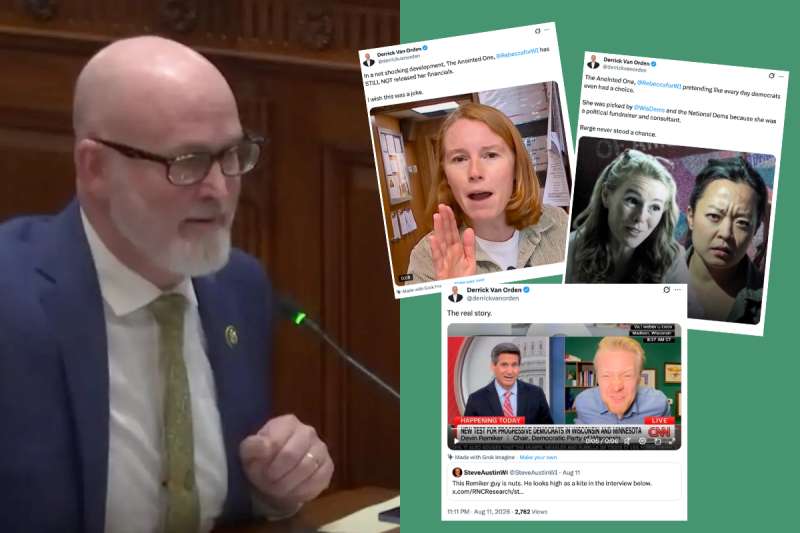
In a recent social media post, US Rep. Derrick Van Orden published a contentious video of his Democratic challenger, Rebecca Cooke, with a pearl-clutching caption: “I wish this was a joke.”
But it is a joke. The video is fake.
While it is not illegal, it puts Van Orden at odds with the intent of state law, as Wisconsin is one of the few states that have specifically targeted so-called deepfake videos generated by artificial intelligence (AI) computing. His repeated postings also raises questions about the ethics of politicians using fake videos to depict their opponents saying things they didn’t really say. Van Orden’s decision to embrace deepfakes also exacerbates concerns about men feeling emboldened to use AI technology to depict women in whatever form they wish.
“Do you really think it matters what you peasants think?” says the fake version of Cooke scowling and pointing at the viewer. “I am the anointed one. You will comply and you will vote for me. That is an order from your DC masters.”
While it’s debatable whether many viewers think Cooke would actually say such things, the video and others like it are part of a growing number of fake videos where politicians put words in the mouths of their opponents.
In New York’s 21st Congressional District, Republican Anthony Constantino released a deepfake video this week depicting his opponent, Democratic congressional candidate Blake Gendebien, saying things he never said.
“I’m mad as hell that President Trump closed the borders and stopped the trafficking of children,” the fake Gendebien says in Constantino’s video. “Democrats want more trans kids [and] more illegal immigration.”
“My initial response was, boy, Anthony has nothing to run on,” said the real Gendebien in response to the video, “so he’s putting words in my mouth.”
Whether these videos are seemingly for entertainment value or to sow confusion, a number of lawmakers have seen the need to rein in the use of technical trickery.
Wisconsin bans deepfakes in political ads
Gov. Tony Evers signed Wisconsin’s restriction on political deepfakes into law in March 2024. The bill, which passed without opposition in both the Assembly and Senate, was sponsored by Rep. Adam Neylon (R-Pewaukee) who said the legislation was needed because AI “can make it nearly impossible to distinguish between fact and fiction in advertisements. By requiring transparency in campaign communications, we can ensure Wisconsin residents remain informed.”
Wisconsin Statute 11.1303(2)(c) makes it clear that every political video “shall include throughout the duration of each portion of the communication containing synthetic media, in writing that is readable, legible, and readily accessible, the words “This video content generated by AI.”
Van Orden’s fake videos contain no such language on the images themselves. The platform X (formerly Twitter) has fine print below the video that says, “Made with Grok imaging.”
Spectrum News reached out to Van Orden’s campaign for comment. The response on behalf of the volatile congressman did not address the video, only attacking Cooke.
Cooke’s campaign told Spectrum News, “This sort of slop is what frustrates people on both sides of the aisle. It’s nasty mudslinging and character defamation. Deception like this should be illegal. But unfortunately Congress hasn’t passed any laws to help that stand up in court. We need leaders in Congress to put guardrails on this technology to protect our communities.”
Rep. Jodi Emerson (D-Eau Claire), a co-sponsor of the state statute, said Van Orden should not get a pass simply because he did not directly violate the law.
“What Congressman Van Orden did is legal because it wasn’t paid advertising, but it certainly isn’t within the spirit of the law,” Emerson told UpNorthNews. “Voters need to be able to trust what they are seeing and hearing is the truth; that’s why we passed the law.”
“The part that bothers me most is that we need serious people in these positions who are working to make sure voters have accurate information, not making things up to confuse voters and ridicule a candidate,” Emerson said. “I don’t need my congressman acting like a teenager to make fun of one of his constituents by using AI. We expect better from our leaders.”
“The more Van Orden posts poorly generated AI videos while ignoring his constituents, the more clear it is that he is unstable and unfit for office,” said Haley King, spokesperson for the Democratic Party of Wisconsin.
The concern about deepfakes cuts across party lines. Sen. Amy Klobuchar (D-Minnesota) teamed up with Sen. Ted Cruz (R-Texas) last year to pass the “Take It Down” Act, which President Donald Trump signed into law, creating strict penalties for the online distribution of non-consensual intimate imagery, sometimes called revenge porn.
Deepfakes’ danger to democracy
The Brennan Center for Justice said that while some AI programs can debunk election misinformation and resist creating deepfakes, it isn’t difficult to use multiple chatbots to get around initial obstacles.
“The chatbots were skilled at helping to create election disinformation and were not very good at discerning what content was fake and what was real,” according to the Brennan Center’s new report, How AI Might Affect Elections. “We asked each chatbot to help us create the kinds of images that will ring familiar to those worried about election conspiracies. Election workers stuffing ballot boxes. Large numbers of non-U.S. citizens voting. Voting machines being rigged. And so on.”
The Brennan Center report concludes with an ominous warning to anyone concerned about the impact of cutting edge technology on democracy.
“We can’t have a robust debate or fair electoral decisions if we cannot trust the information by which we vote and with which elections are run.”