Reporting by Caden Perry, Milwaukee Journal Sentinel / Milwaukee Journal Sentinel
Here are answers to some of the most common smoke-related questions.
How long will air quality be bad in Wisconsin?
The smoke is expected to stay in the air through at least Friday afternoon, July 17. National Weather Service models forecast that wind could provide some relief by then, but most smoke will remain through Monday, July 20.
What air quality is dangerous to breathe?
All smoke is dangerous to breathe, but public agencies use a color-coded system to interpret how bad pollutants are at any given time with the Air Quality Index.
- Green (AQI 0-50): Air quality is satisfactory, and air pollution poses little or no risk.
- Yellow (AQI 51-100): Air quality is acceptable. However, there may be a risk for some people, particularly those who are unusually sensitive to air pollution.
- Orange (AQI 101-150): Members of sensitive groups may experience health effects. The general public is less likely to be affected.
- Red (AQI 151-200): Some members of the general public may experience health effects; members of sensitive groups may experience more serious health effects.
- Purple (AQI 201-300): Health alert: The risk of health effects is increased for everyone.
- Maroon (AQI 301+): Health warning of emergency conditions: everyone is more likely to be affected.
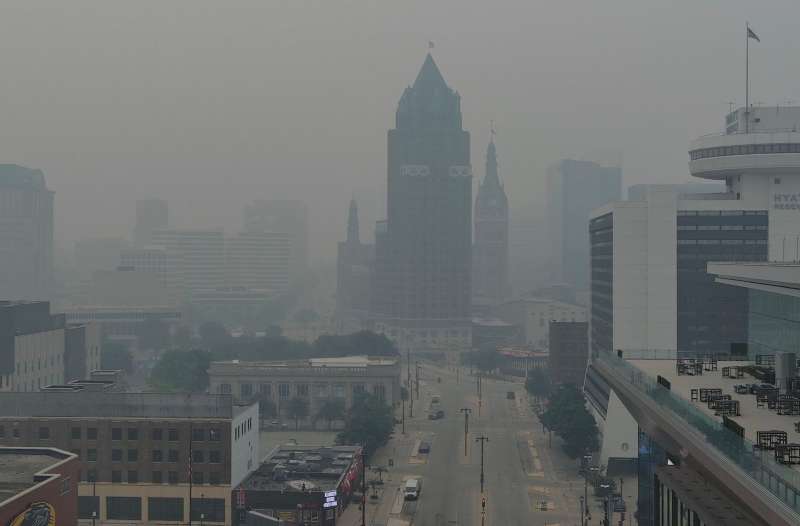
As of Thursday, July 16, most of Wisconsin was in the purple or maroon AQI categories.
Where are the wildfires bringing smoke to Wisconsin?
Most of the wildfires bringing smoke to Wisconsin are blazing in southern Canada above the Great Lakes. On Thursday, July 16 about 900 fires were active across North America.
Some fires are also active in northern Minnesota around the Boundary Waters region.
How can I check air quality?
There are several sources for checking Air Quality Index, but the most thorough is the Environmental Protection Agency’s AirNow map. AirNow uses air monitor reports from public institutions to create a live map of air quality across the United States. and southern Canada.
Why do Canadian wildfires bring smoke to Wisconsin?
When wildfires create smoke, it rises into the atmosphere. After traveling across the atmosphere, high-pressure weather systems can pull the smoky air down to the surface, where humans and animals breathe it in.
High-pressure systems are usually characterized by low moisture and calm winds. In contrast, storms and rainy weather will keep smoke at bay.
How long has Wisconsin been under an air quality alert?
The National Weather Service and Wisconsin Department of Natural Resources issued the first air quality alert on Tuesday, July 14. It was originally set to expire at noon Thursday, July 16, but that was extended to Friday, July 17 with another extension anticipated.
This article originally appeared on Milwaukee Journal Sentinel: When will Wisconsin air quality improve? Wildfire smoke questions answered
USA TODAY Network via Reuters Connect