Reporting by Jack Albright, Milwaukee Journal Sentinel / Milwaukee Journal Sentinel
On his 53rd day in the Pacific Ocean, Johnny Martinez woke up and cried. For the first time in almost two months, as the morning clouds broke to reveal Maui’s jagged coast, he saw land.
For days, Martinez and the rest of his four-man crew — Greg Anderson, Joshua Dukes and Wilton Ngotel — wondered when the island would come into view from their rowboat. Other sailors told them it is visible more than 100 miles away, but clouds kept blocking their sight. Not even binoculars cut through.
For seven weeks, the team battled up to 20-foot waves, 35 mph winds and the mighty Pacific on its 3,100-mile journey from Washington to Hawaii in a 25-foot rowboat. No engine. No sails. No support ship.
Just four oars and four adrenaline junkies alone on the world’s biggest ocean.
Their boat was merely 17 miles away from Maui when the Hawaiian island finally appeared, its peaks looming high in the distance while a rainbow shot into the sky. The first to see it, Martinez broke down immediately.
“It was magical,” the 32-year-old Oconomowoc native told the Milwaukee Journal Sentinel.
They were going to survive.
Trip across ocean ‘was always a spiritual and mental test’ for Martinez
Given his recent quest, it’s hard to believe Martinez when he says he doesn’t love the water. He loves adventure, preferably on land. Hiking mountains, running on trails.
His first experience navigating an ocean was the row to Hawaii.
He was supposed to have lived on a boat while in the Marine Corps, where he served as an air winger from 2013-’17. Normally, for every three rotations on land, Marines need to do one on water.
Martinez didn’t, though.
“Thankfully I didn’t have to,” he said.
He got a DUI in 2016 and was asked not to re-enlist. After leaving the Marines, he jumped between odd jobs before becoming an electrician. On weekends and time off, he traveled around the country, camping in his car. He’d gone as far south as Florida and Louisiana, as far west as Yellowstone.
“Really trying to explore as much as I can,” Martinez said. So long as it was on land.
Until Greg Anderson texted him last fall. Anderson was putting together a team to row across the Pacific, and he wanted Martinez to be on it. Martinez answered Anderson in two minutes. I’m 100% in.
At the time, Martinez didn’t always like the person he saw looking back in the mirror. He was angry at the world, racked with self-doubt and questioning everything about the man he’d become.
Am I a good dad? I just got divorced, what does that say about me? Am I seeking attention, or purpose?
He had been finding new places to hike. What he wanted was to find himself.
He thought the best place might be the Pacific. Martinez saw the endless teal water as the biggest mirror of all, reflecting back at whoever enters it. Martinez wanted to make sure when he looked down off the boat, he saw a person he was proud to be.
Martinez’s training on the water was limited to less than an hour a day, a couple of times each week.
“Out of the team, I probably rowed the least amount in preparation for this,” he said.
But the physical requirements were never a worry.
“It was always a spiritual and mental test,” Martinez said.
His “training” focused on passing that test. He journaled every day. Meditated with a smudge stick. Sat in a sauna or hot tub for as long as he rowed. Tried to find inner peace.
“I spent a lot of time in that space and I’m very happy that I did,” Martinez said.
On May 1, the team left Quileute Harbor Marina in the small, coastal town of La Push, Washington.
Martinez battled sluggishness, hunger, homesickness and more on trip
Life on the boat was harsh. Unforgiving. Creature comforts like a mattress or flushable toilet were thousands of miles behind in Washington. After running out of snacks, their only food was freeze-dried meals cooked with a jet-boil. Their “bathroom” was a bucket, their “shower” a portable pump meant for camping. They’d ball their shirts into “pillows.”
The “beds” — each shared by two people — were one-inch thick sleeping mats, which did little to cushion the boat cabin’s cold, hard floor. When it was chilly outside, like at the start of the trip, their body heat would produce condensation. Mold quickly grew on their wet shirts and bags.
The crew split rowing duties into three-hour increments, two people manning the oars at all times. Martinez was with Anderson; Dukes and Ngotel rowed the other shifts. The only time they didn’t row was during storms, when it was too dangerous to paddle.
Martinez could not eat or drink anything for the first five days, and dealt with seasickness for the first 28 days. Taking Zofran to help keep his food down, he then didn’t have a bowel movement for nine days.
On the second week of the trip, off the southern coast of Oregon, the crew had to deploy an underwater parachute to stabilize the boat amid 25-foot waves and gale force winds. Martinez and his roommate Ngotel crammed into their tiny sleeping cabin, and stayed there all day and night. Martinez could hear the taut parachute ropes stressing and straining before whipping the boat around.
“It was 48 hours of that,” Martinez said.
The waves were so fierce he thought the ropes might snap or the boat might break in half, ending his life. But he said nothing.
“While all of us had those fears,” Martinez said, “it was never projected outwardly. None of us were ever panicking.”
Conditions take their toll on sleep-deprived crew
As the trip continued, crew members tried to keep themselves clean. Martinez also would call his girlfriend, Amelia, to update her and reflect on the trip. He maintained his journaling and meditating. Anything to focus his thoughts on why he was out there, what he was searching for, how he felt about doing this. Then he would try to get some sleep before waking up a couple of hours later and rowing again.
The conditions took their toll.
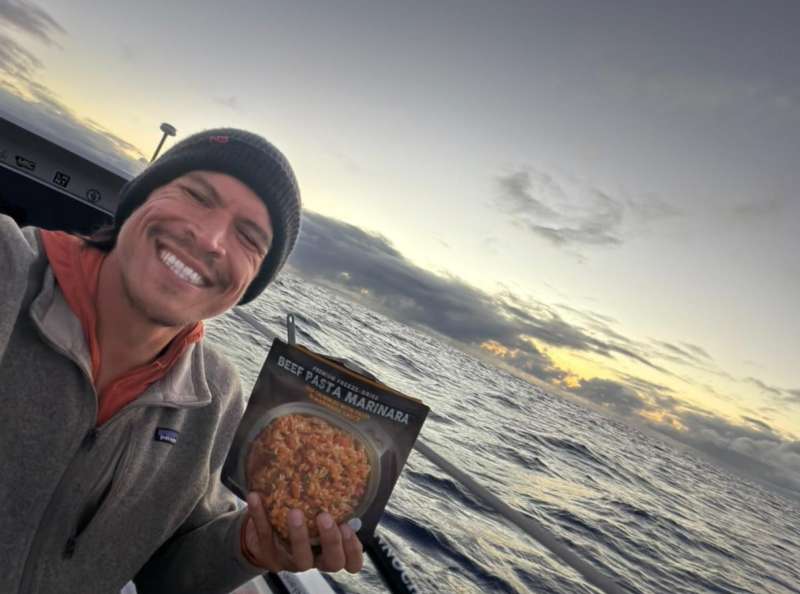
Everyone battled sleep deprivation, which got so bad they forgot the names of their food packets. Beef pasta marinade turned into beef paste marinade because they misread the word. Strawberry granola became raspberry crunch. Nobody reacted to their alarms, no matter how many they set, meaning the last act of most rowing shifts was waking up teammates to switch spots.
Martinez had vivid daydreams, usually about food, something he’d never experienced before. Cornbread and different meats from David Alan Alan’s Smokehouse & Saloon in Mukwonago became common subjects.
Aches and pains; hunger and thirst; fatigue and fantasizing. The crew had to cope with those and the ocean’s elements all at once. Harsh rain and winds buffeted them. Multiple animals — a baby shark, a seal and more — attached themselves to the oars. A hot, humid climate meant no relief from a sweltering sun.
What helped the crew survive despite little experience was their trust. Trust in each other.
Before they departed, ground rules were set: There would be frustrations, but crew mates would not lash out at each other. When airing grievances, do it out of respect, not anger.
“I was frustrated many times at points over my teammates,” Martinez said. “But, for me to show up and then create a hostile work environment, it’s pretty unnecessary at that point in time.”
Completing 3,000-mile journey felt like a new beginning for Martinez
Martinez finished wiping his eyes at the first sights of Maui, and composed himself. He still had rowing to do.
In that moment, a lot went through his mind. He had actually, physically, helped row a boat more than 3,000 miles across an ocean. More important, he had become renewed.
The anger that consumed him was gone. He was no longer frustrated with himself, his thoughts. He looked down in the mirror that is the Pacific, and saw someone with love and happiness staring up at him. It was a reflection of the person he wants to be, and had worked so hard to become.
His journey on the boat had ended; his life was beginning.
“Because I fought so hard to get to this spot,” Martinez said, “I couldn’t imagine anything that could shake that.”
When the crew docked in Kahului Harbor and touched land for the first time in 53 days, more than 100 people welcomed them. Multiple Hawaiian news crew showed up to document the achievement. Joshua Dukes, one of the crew members, has lived in Maui for 27 years, and had almost 80 friends there.
Crew members enjoyed their first real food in months, and took pictures with friends and families. Locals placed leis around their necks and crowns made of plants on their heads.
Martinez’s girlfriend was there to support him. When it was their turn for a photo, he waited for the camera to click, then dropped to one knee. Reaching into his pocket, he pulled two rings made of parachute cord he had fashioned on the boat, and proposed.
Martinez pushed off the dock in Washington with a girlfriend, and walked off the one in Hawaii with a fiancée.
“I’ve said it and have always meant that I don’t see myself with anybody else in this world besides her,” Martinez said. “It was just fear holding me back.”
After welcome party for the group ended, Martinez attended one more — this one just for him. Growing up, he thought he was Mexican or Hispanic. Six years ago, he found out he was Hawaiian. But, he didn’t know much else. Early into the voyage, Martinez started talking over the phone with some of his relatives on the islands, turning the trip into a homecoming.
Meeting them would be his last stop before returning to the mainland. He and Amelia went from Maui to O’ahu for 24 hours, staying with his newfound aunts and uncles. They taught him the history of his lineage, how his ancestry dates back to Kamehameha I, the first ruler of Hawaii who unified the kingdom in 1810.
“It’s still quite new and fresh for me,” Martinez said.
He learned one of his cousins, Samson Harp, is a tattoo artist. Harp inked Martinez left leg with two bands that run from his ankle to his hip, almost like a spear split in half, running up and then back down. Each band contains spear tips end to end. It’s his ancestors’ family crest.
The final, permanent mark of a man remade.
Jack Albright can be reached at JAlbright@usatodayco.com.
This article originally appeared on Milwaukee Journal Sentinel: Oconomowoc’s Johnny Martinez finds peace in 3,000-mile row across Pacific
USA TODAY Network via Reuters Connect