Reporting by Sophie Carson, Milwaukee Journal Sentinel / Milwaukee Journal Sentinel
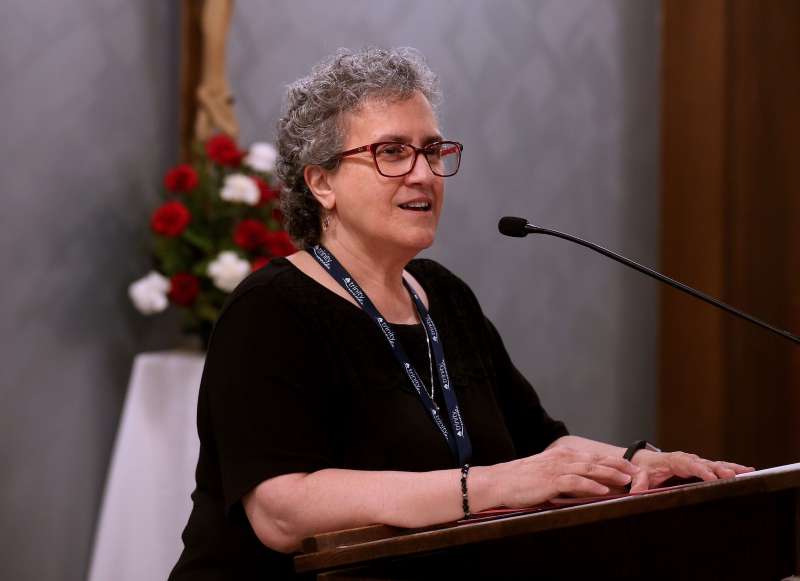
Sister Debra Sciano on Aug. 14 became the president of the Leadership Conference of Women Religious, or LCWR. The group represents about two-thirds of all 35,000 Catholic sisters in the U.S., whom some colloquially call nuns.
She’s taking her unique life experience – as an assistant district attorney for Milwaukee County in Children’s Court, as a family mediator, and as a leader who’s overseen consolidation and creative solutions in her own religious order – to the national level.
Even as the population of Catholic sisters in the U.S. ages and declines, and groups make tough decisions about what to do with underused properties, Sciano projected a message of hope. She pointed to the increase in sisters in Africa, central and South America and elsewhere, and the partnerships congregations can make with outside groups.
“Our mission is alive and well,” she said. “We need to be creative and resourceful. And the big thing is collaboration, capital C.”
Sister Debra Sciano oversaw big changes to School Sisters in Milwaukee
Sciano, 68, is a longtime leader in her own religious order, the School Sisters of Notre Dame. Locally, the order is affiliated with Mount Mary University and the Notre Dame School of Milwaukee, a bilingual elementary school on the city’s south side. Outside Milwaukee, it has a presence in 19 other states and several countries.
Out of the nearly 1,600 School Sisters of Notre Dame globally, the region Sciano leads – called the Central Pacific province – counts about 600 women in its ranks. It stretches from Wisconsin to Texas, and all the way west to Guam and Japan.
Facing many of the same unavoidable demographic headwinds as other Catholic religious orders, the province under Sciano has gotten creative to keep their mission alive and set themselves up for the future. Until a consolidation about 15 years ago, Milwaukee was its own province. Leaders have taken several steps since then.
On Mount Mary’s campus, the order opened Trinity Woods in 2022, a housing complex for retired sisters and retired lay people as well as single mothers with children who attend Mount Mary. It was believed to be the first facility in the U.S. to house religious sisters, seniors and parenting college students.
Trinity Woods is a partnership with the Milwaukee Catholic Home, which operates the facility.
The year prior, the School Sisters decided to move from the Elm Grove complex they had called home since 1859. Sciano said the sisters could no longer afford the complex, and many of its rooms were no longer in use. The Elm Grove campus has been turned into luxury apartments.
And inside the Clement Manor senior living complex in Greenfield is a memory care facility specifically for Catholic sisters. It’s a collaboration between the School Sisters and several other religious orders.
“The future is bright,” she said. Partnerships are “the way of the present and, I believe, the future.”
Sciano is a graduate of the University of Wisconsin-Milwaukee and St. Thomas University in Miami, where she earned a law degree. When she became a sister, she asked if she could also pursue law school, and she got the green light. She worked as an assistant district attorney, mainly in Children’s Court, for 13 years, handling cases involving abuse and neglect, guardianship and delinquency, among other issues.
“I knew from childhood on I wanted to be a lawyer. My first calling, really, was to go into law and to work with families, particularly children, and those who were oppressed and in need,” Sciano said.
After her time as a prosecutor, she spent a decade in leadership of her School Sisters province. Then, she became certified as a family mediator, helping people going through divorce resolve issues outside of court. She has spent the last several years again at the helm of the School Sisters’ Central Pacific province.
Association of Catholic sisters links leaders, advocates for key issues
The LCWR, which Sciano now leads, is considered the more liberal of the two major associations of Catholic sisters. The other group, the Council of Major Superiors of Women Religious, is smaller, with about 5,700 sisters, tends to be as younger, and is considered more traditional or conservative. The women typically wear habits, while women in LCWR congregations do not.
In the U.S., LCWR’s sisters are generally older, a legacy of the boom in people entering religious life in the mid-20th century. In Milwaukee and other cities, the sisters made their mark by founding schools, hospitals, universities and often-sprawling convent complexes.
By one measure, Milwaukee has seen the decline in Catholic sisters most acutely. From 2000 to 2016, the Archdiocese of Milwaukee recorded a drop of 1,800 sisters, according to data compiled by the Catholic GeoHub, a project of the nonprofit GoodLands. That’s more than any other diocese in the U.S.
The LCWR links together all the leaders of each religious order, offering them resources and connection as they plot their futures. It also serves as a public advocacy voice on issues important to the sisters. Their main areas of focus include immigration, climate change and racism, which Sciano described as interlinked.
“Many of [our communities] were founded to meet the needs of immigrants hundreds of years ago,” Sciano said.
Sciano has been part of the leadership corps of the LCWR since last year. The president-elect, president and past president serve on a three-person team. So in March, she traveled with the team to Rome, where they met with Pope Leo XIV for 45 minutes, she said.
They discussed their concerns about the world, the work the sisters had been doing and how to collaborate with U.S. bishops and the church hierarchy, she said.
“It was so obvious, his great listening and care and compassion,” Sciano said. “He’s very supportive of religious women.”
The School Sisters of Notre Dame were historically educators. Now, Sciano sees the order’s mission as education “in the broadest sense.” Unity is the overarching goal.
“It’s needed now more than ever,” she said. “There’s so much divisiveness, and hurtfulness, and need for healing.”
Sophie Carson is a general assignment reporter who reports on religion and faith, immigrants and refugees and more. Contact her at scarson@gannett.com or 920-323-5758.
This article originally appeared on Milwaukee Journal Sentinel: She was a Milwaukee prosecutor. Now she leads most of the nation’s Catholic sisters
USA TODAY Network via Reuters Connect