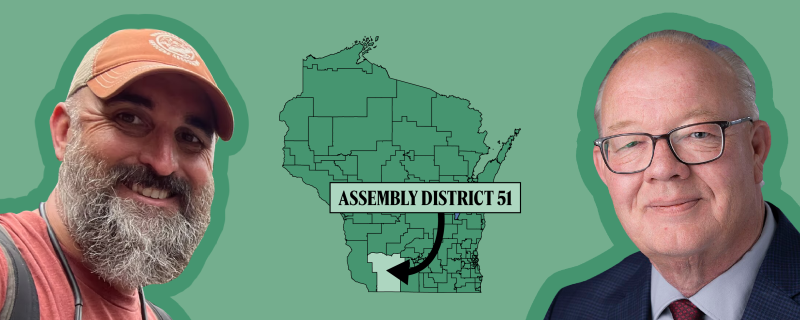
Ben Gruber lives in the house his parents built and he spent most of his childhood in. It sits in the small village of Arena in Iowa County, just a mile-and-a-half from where his family first lived when he was young.
“We were so close that when we moved to this place, we didn’t trailer the horses, we just rode them over,” Gruber shared with UpNorthNews.
He’s got quite a history there. “My first buck, first tractor, first farmhouse—all right here in the town of Arena,” Gruber said.
But Gruber gathered experience as he ventured across the state for work. When he ultimately returned, he was a little more seasoned—but a little more frustrated, too.
“The year before we moved back into this house—my wife and I and my two daughters—our local elementary school closed. That was the elementary school that I went to, and after that closed, it meant a 97-minute bus ride for my 5-year-old daughter to get to kindergarten,” he said.
A few years after that, the village police department shut down. “We had to choose between water to flush the toilets or public safety, because our communities have been defunded by the state legislature for 10-plus years so we can continue to give corporate welfare and tax breaks to billionaires,” said Gruber.
That’s when Gruber decided he wanted to do something about it.
“This has never been something that I thought I would do with my life—run for public office.”
Gruber is running as a Democratic candidate for the Wisconsin State Assembly to represent District 51.
Seeing policies fail in real time
Gruber didn’t need to read about problems in reports or the news.He lived them—sometimes during 24-hour shifts.
“I’ve shown up my whole life for this community, whether that’s been when your grandma fell and needed help getting up, or your house was on fire, or you needed a rescue on the river,” Gruber said.
Gruber has worked as a firefighter, paramedic, EMT, police officer, labor leader, conservation warden, and volunteer mentor to kids.
“I’ve spent my whole life serving these people. To watch our communities struggle because we’re more concerned about taking care of billionaires and giving away corporate welfare, you know, $2 billion, almost $3 billion to Microsoft and Meta from the state in the last budget cycle while our neighbors can’t afford insulin for their kids—I truly believe we can do better.”, Gruber said.
“We continue to see our property taxes go up, which just increases the burden on people on fixed incomes and working families, and at the same time, the services that we’re getting for that are going down.”
Gruber brings real-world credibility to the collapse of rural emergency services and healthcare budget cuts. “As somebody who’s been an EMT in our community, who’s worked as a paramedic, and really worked in healthcare systems across the state, we’re approaching a real crisis point,” he said.
He points to western Wisconsin, where the Hospital Sisters Health System (HSHS) abruptly shut down Sacred Heart Hospital in Eau Claire and St. Joseph’s Hospital in Chippewa Falls in early 2024, along with related Prevea Health clinics, citing financial stress. More than 1,400 employees lost their livelihoods on short notice. The region lost two emergency rooms, labor and delivery units, a cancer center, inpatient psychiatric care, and over 100 hospital beds.
He used the word “devastating” to describe the situation if it were to be replayed in southwestern Wisconsin, stating that the district is already struggling to staff its ambulances.
As federal funding cuts loom, Gruber believes the closure of at least one rural healthcare facility is “incredibly likely.”
“It would significantly increase the burden on our volunteer EMS systems when they now have to transport 30 or 60 minutes farther when they have somebody who’s in labor giving birth, somebody who’s having a heart attack or a stroke,” he said.
Gruber, along with many healthcare advocates, legislators, and providers, described upcoming 2026 Medicaid and Medicare policy shifts as a brewing healthcare crisis.
The Trump administration’s One Big Beautiful Bill Act will slash federal healthcare spending by roughly $1 trillion over a decade, with major enforcement and eligibility restrictions scheduled to take effect right after the November election.
“I don’t know if we’re going to be able to absorb those and continue operating as we are,” Gruber said. “We see more patients needing heart care, stroke care, and specialty care having to be transferred out to Madison or Dubuque, and it’s going to get worse if we don’t intervene and do something.”
Running for change
Wisconsin’s 51st Assembly District is in the southern part of the state. It includes all of Iowa and Lafayette Counties and parts of western Dane and eastern Grant Counties, with cities like Dodgeville, Mineral Point, Darlington, Cuba City, and Mount Horeb.
“These are primarily rural, hardworking people who care about our neighbors, and we show up and we’re willing to do the work, and we don’t expect things to be handed to us, nor do we expect our hard work to only benefit billionaires,” Gruber said.
The seat is held by incumbent Republican Todd Novak of Dodgeville. Nathan Tataje of Arena is also running for the American Solidarity Party.
Democrats need to flip two seats to take control of the state Senate and five seats to win the Assembly.
“People here don’t necessarily vote for party alignment,” Gruber explained. “They tend to be discerning about who the people that are running are and what they want, and I really appreciate that.”
The race is considered a top-tier battleground as the district leans slightly Democratic. Despite the partisan tilt, Novak has held the seat since 2014.
“I’m running against somebody who’s been in office for 12-plus years, and during that time, I would struggle to talk to anybody across our district who feels like their life has got markedly better based on actions from the state legislature,” said Gruber.
“We see a lot of talk about healthcare and public school funding. This incumbent’s had years to figure this out, so any claims that those are things that he’s focused on, quite frankly, that dog don’t hunt.”
Bringing firsthand insight into the race
Gruber said he wants to shift out of “emergency response mode,” instead addressing root causes to prevent crises from happening in the first place.
He calls public school funding a day one priority. “We have got to fix public school funding, and that doesn’t just fix things for people who have kids in school, it fixes property taxes for people on fixed incomes,” Gruber said. “It helps us recruit and retain talent in our communities.”
Gruber also champions fixing shared revenue and prioritizing protecting natural resources.
Serving as a Department of Natural Resources (DNR) conservation warden gives Gruber direct insight into keeping outdoor recreation safe. He hopes to resurrect the Knowles-Nelson Stewardship Grant program, which is Wisconsin’s highly regarded conservation program that ended in June after lawmakers failed to reauthorize it.
“We’ve got to fund things like Knowles-Nelson’s stewardship,” Gruber said. “And we’ve got to ensure that the people—whether you’re on a village water system or a rural well—that when you turn on the tap, you have clean water to drink.”
“We cannot allow corporate polluters to get away scot-free and pollute the water that we need to drink and live.”
Gruber’s boots-on-the ground-career is shaping his goals and determination. “I think what’s important is to focus on somebody who will stand up and fight for a community, who has a history of public service, who’s willing to stick their neck out there for the people who, for a long time, have felt like they haven’t had a voice,” he said. “And that’s what I’m going to do.”