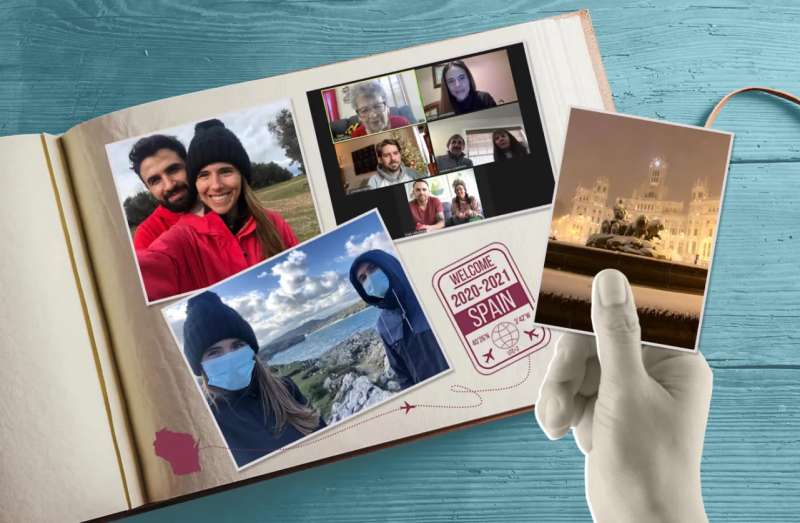
Visits using technology helped maintain connections with family and friends during difficult times.
Editor’s note: One year ago, UpNorthNews reporter Julian Emerson interviewed Megan La Barbera, an Eau Claire native who now lives in Madrid, Spain, as a nationwide lockdown was being initiated there because of the coronavirus outbreak. Last week Emerson caught up with La Barbera to discuss the last year living in Spain during the pandemic.
One year after the coronavirus pandemic raged across Spain, overwhelming hospitals and forcing a strict, widespread lockdown, some of those regulations have disappeared as the deadly virus has receded, said Megan La Barbera, a Wisconsin native who lives there.
Rules that once confined the 3.4 million people in Madrid to their homes, except for trips deemed necessary, have been replaced by people walking the streets, with some returning to their work sites. Hospitals are no longer overrun by people infected with and dying from the virus.
Spain’s residents still wear masks in public, and restrictions at restaurants, taverns and other indoor locations are in effect. Gatherings at such locations are no longer prohibited, although government officials in parts of Spain have tightened COVID-19-related regulations recently as virus cases have begun to climb there and in several other European nations.
“There is definitely more optimism, more of a sense of hope that people seem to have,” said La Barbera, 31, who grew up in Eau Claire but has called Madrid home for the past seven years. “After the challenges of that last year, people feel a sense of relief and hope we can get back to normal.”
Those feelings are distinctly different than a little more than a year ago, when the government instituted a lockdown in the capital city and the rest of Spain in an effort to reduce the spread of the virus as it surged in that nation. At that time, La Barbera said, she felt a mix of frustration and fear as she pondered how she and her fiancé, César Gutiérrez Fernández, would stay safe from the virus and navigate their busy lives.
Would they be able to work effectively from their small one-bedroom apartment? How often would they be allowed to leave to get groceries or other necessities? How would they stay safe from the contagious coronavirus living in crowded conditions among the 3.4 million people around them?
As the number of cases and deaths related to the virus continued to climb, La Barbera’s anxiety grew.
“It was definitely scary, that’s for sure,” she said. “We were hearing about all of the (virus) cases, how hospitals were overwhelmed. We realized we had to do everything we could to stay safe.”
That meant rarely leaving the couple’s tiny apartment, departing only for essential trips. The duo did their best to maintain as much of their normal life as possible, including exercising. But it wasn’t easy.
La Barbera and Fernández worked, worked out, and conducted all other life activities in their home for two months before the lockdown was lifted.
“We had to get really creative to make it work,” said La Barbrera, who is program coordinator at a business school in Spain where in-person courses were cancelled. “To be honest, those two months (on lockdown) are a bit of a blur.”
Once restrictions were eased a bit, La Barbera and others were afraid to gather together, she said, mindful of the fact the virus was still present and the heavy toll it had taken in the country. An estimated 3.3 million people in Spain have been infected with the virus, and at least 76,037 deaths have been attributed to the virus. In Madrid, those figures are 633,000 infections and nearly 15,000 deaths.
The virus has flared several times in Spain during the year since its initial surge. In October and November, COVID-19 cases and deaths ramped up significantly in La Barbera’s hometown and elsewhere in Wisconsin and across the US.
La Barbera’s parents, retired educators Michael “Chico” and Jill, reside in Eau Claire. As the virus overwhelmed hospitals across Wisconsin last fall, La Barbera worried about them.
“At their age, they were certainly at risk,” she said of her parents. “But I knew they would be safe, that they would do everything they could to prevent being infected.”
Jill and Michael worried about their daughter too, as well as their son John, who lives in New York, which was hit especially hard by the pandemic a year ago.
“A big part of it at that time was the fear of the unknown,” Michael recalled. “When you read the horrific stories of hospitals having to choose who’s going to live and who will die, it plays tricks on your mind about what could happen.”
Despite the distance between them, the La Barbera family typically gets together several times yearly. With travel not allowed because of COVID-19, they relied on FaceTime and Zoom to stay in touch. Technology has provided a much-needed lifeline during the pandemic, helping stave off further worry and depression, they said.
“We were bummed out about not being able to see each other,” Jill said, “but being able to visit using technology has helped.”
Among the many life disruptions La Barbera and Fernández faced was the delay of their marriage. They had planned to gather with family to wed last year, and again next month, but the pandemic made that impossible. The couple now plans to marry in May 2022 if possible.
That wedding and other gatherings seem more likely, La Barbera said, with the rollout of COVID-19 vaccinations. She was happy to hear her parents have been vaccinated and eagerly anticipates receiving the vaccine herself.
However, vaccinations are occurring more slowly in Spain than in the US, she said, and she may not get hers until the fall. “Hopefully it will happen sooner than later,” she said.
As she reflects on a year that has been historically tumultuous, La Barbera said she is grateful for so much, for the fact she and Fernández were able to work from home safely and avoided contracting the virus, for the safety of her family members. She looks forward to simple pleasures, to once again gathering with her family, with friends, to dining at her favorite restaurants or sharing conversation with others over a cup of coffee.
“After this past year, after all of the challenges, I think we’ve learned not to take anything for granted,” La Barbera said. “You realize how much the little things matter.”