A strong Democratic contender will go up against a powerful Republican incumbent this November as the two vie for the Senate District 17 seat in southwest Wisconsin. The race for this district gives Democrats their first real opportunity in decades to reclaim the seat, which Republicans have held since Dale Schultz took office in 1991. Before Schultz, Senator Dick Kruel, also a Republican, served in another version of SD-17 beginning in 1978. In 2024, the district was redrawn.
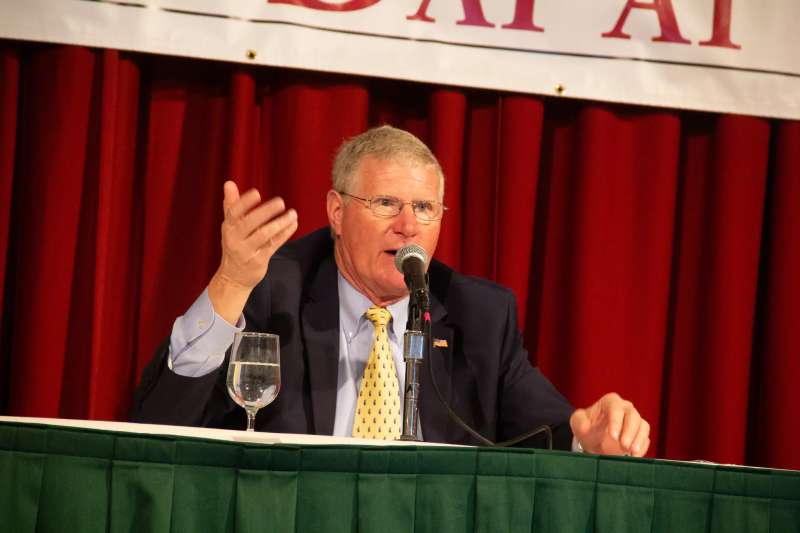
On Nov. 3, Republican incumbent Sen. Howard Marklein will face off with Democrat Jenna Jacobson, a current state rep who won the primary against two other women in a three-way race on Aug. 11. Marklein has tenure on his side, having taken office in 2015. He’s also co-chair of the Joint Finance Committee and chair of the Senate Finance Committee. But if Jacobson wins, experts believe Dems will have a real shot at gaining control of the chamber.
“The 17th district is one of the best opportunities for the Democrats to flip a seat. It will not be easy because Marklein is a familiar and successful incumbent who has represented the area for a decade and a half,” said Barry Burden, a professor of political science at the University of Wisconsin-Madison.
“The 2026 cycle will be his toughest test because of three factors: a new district, a formidable opponent who serves in the state legislature, and a national political environment under President Trump that advantages the Democrats.”
The district
This year’s election marks the first time voters will convene to elect a leader since SD-17 was redrawn in 2024. When Marklein last won the district in 2022, the boundaries were the old ones. Now the district skews much bluer.
“Sen. Marklein repped the seat and won it when it was a Trump-plus-15 seat, and so now it’s been drastically redrawn and gotten more compact,” said Andrew Whitley, Executive Director of the Wisconsin State Senate Democratic Committee. “It doesn’t jut out and grab parts of Juneau and Adams County up north, it’s squarely Southwest Wisconsin. So it’s turned from a Trump double-digit district to a Harris-plus-one seat, so a pretty big change.”
Whitley called the district’s new makeup an interesting one, explaining that the further west you go within the boundary line, the more rural the area becomes.
“It remains rural, but it already flipped for Kamala and grabbed Republican strongholds in the north,” Whitley adds. “It looks very different compared to what it used to.”
Burden agrees that redistricting will have a major impact on the race this cycle.
“The district went from having a substantial Republican tilt in 2022 to having a modest Democratic lean in 2026,” Burden said. “That was accomplished by moving bluer parts of western Dane County and Green County into the district and moving redder parts of Crawford, Richland, and Sauk into other districts.”
Results from the last presidential election showed that the area has begun to turn blue, indicating a new landscape that will affect outcomes.
“Kamala Harris narrowly edged Donald Trump in the district,” Burden added. “This means that incumbent Howard Marklein now faces a district where more voters have not seen him on the ballot before and where more of them are Democrats.”
The candidates for SD-17
Marklein has served the district since 2015 and co-chairs the Senate Finance Committee. But when it comes to key issues voters care about in the state, Philip Shulman, director of communications for the Democratic Party of Wisconsin, said he falls short, voting in favor of big tech and against regular Wisconsinites. He has supported bans on abortion and rejected insurance coverage for infertility treatments. He has also voted against extending bridge payments to help working parents cover the cost of childcare.
“He’s been in office for a decade plus, and he’s cashed checks from lobbyists and special interests and does their bidding on the Senate floor,” Whitley said.
Marklein has accepted money from the fossil fuel industry and utility providers, including $7,000 from the WEC Energy Group PAC and $7,750 from Wisconsin’s. Electric Cooperative PAC.. He recently agreed to offer major tax breaks for data centers. He’s also disclosed investments in Dow Chemical, Eastman Chemical, and Southern Company, a major polluter.
Jacobson currently serves as a state legislator in Assembly District 50, and Whitley says she’s putting in the work for this race. Her team has knocked on nearly 20,000 doors so far, and Jenna herself has done 5,000 of them, Whiteley said.
“She’s not just relying on money to win; she’s putting in the shoe leather too,” Whitley added.
Jacobson is playing the role of the mom next door. She’s part of a bowling league in Oregon and is often seen on the campaign trail in jeans and a T-Shirt. As an assemblywoman, she’s currently representing the eastern third of SD 17. Before that, she served on a village board in Oregon.
“As much as Jenna comes across as a normal person you can see yourself in, Marklein is your typical politician who’s been in Madison too long,” Whitley said.
Jacobson disclosed far fewer investments than her opponent.
The race
National issues will play out locally as voters choose between Jacobson and Marklein, and affordability is at the forefront.
“The top concern in every district is the economy, and more specifically, affordability of nearly everything from gasoline to childcare,” Burden said. “Voters in the district will also be concerned about rapidly increasing property taxes and the building of AI data centers.”
And beyond grocery costs and prices at the pump, Shulman said that the affordability umbrella also extends to health care and utility costs. Jacobson helped to pass a bill expanding postpartum Medicaid for new mothers, while Marklein has accepted campaign funds from the same utility providers, upping costs for residents.
Marklein has also faced criticism for voting to shift energy sources away from wind and solar toward nuclear and fossil fuels. That bill failed.
As Americans increasingly choose local lawmakers based on what’s happening in the White House, it’s likely the candidates will play into those concerns.
“Jacobson will argue that Trump and the Republican-dominated legislature are to blame for economic discontent while Marklein is likely to point the finger at Governor Evers for property tax increases,” Burden said.
And while Marklein has run a campaign in a bluer district this year, he’s trying to signal that he’s willing to work across party lines. Whether that’s enough to persuade voters in the district remains to be seen.
“All the headwinds are just heading against Republicans in the state,” Shulman said.