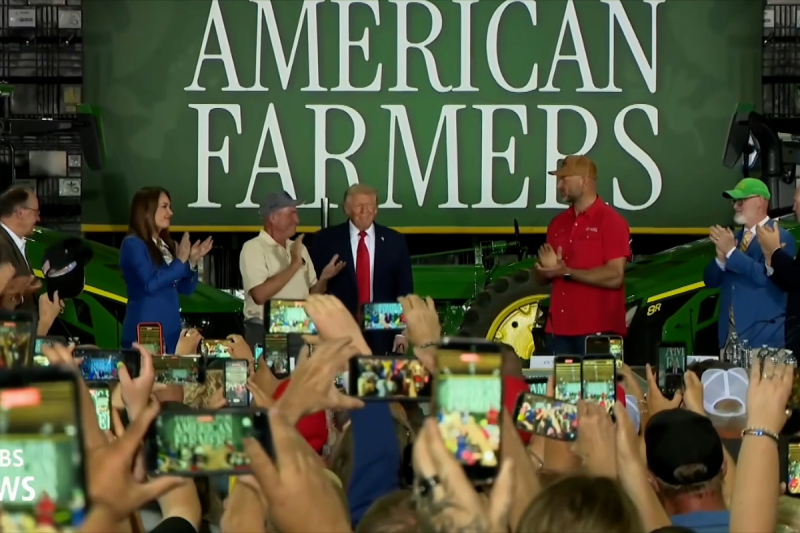
As farmers and supporters packed into a Chippewa County pole barn to avoid a driving rainstorm on June 5, the president of the United States told them all about restoring fountains in Washington, DC, marveled over the physical appearances of two athletes on the stage, and made more baseless claims about election fraud. Sprinkled in between the many tangents, President Donald Trump also talked about what he says he’s done for farmers and the rural economy.
Here’s a review of his claims and promises.
Lower prices, when (or if) the war with Iran ends
Like all American consumers, farmers’ finances are being rocked by record-high fuel prices since Trump started a war with Iran. The resulting supply chain disruption has caused other prices to rise, including fertilizer. Trump said it would all get better soon.
“You’re gonna see it,” Trump said. “And you’re gonna see it a lot better in about three months from now.”
But Trump has made repeated claims about the war and a potential negotiated settlement, each one undone by another flare up in fighting, so his promises about lower prices are on shaky ground at best.
Touted bailouts while ignoring who paid for them
Trump cast himself as a hero to farmers on the subject of global trade.
“You farmers, if you remember, we had a bad patch in my first term where China and other countries were sort of boycotting the United States.”
The boycotts were actually retaliatory tariffs to answer the ones launched by Trump in his first term. The administration doled out taxpayer-funded bailouts totaling $28 billion to make up for the markets lost by farmers in Wisconsin and nationwide.
At the start of his second term, he launched a new trade war, which required another set of bailout payments, referred to officially as “bridge payments” totaling $12 billion so far. But Trump claims the upheaval will result in better trade agreements.
Export markets still lagging
“I just made a great deal,” Trump claimed. “I came back from President Xi, and he’s buying billions and billions of dollars worth of soybeans and other things, and you’re seeing that starting to kick in.”
During Trump’s two-day visit to China last month, Xi did reportedly commit to buying at least $17 billion of various US agricultural goods annually through 2028, but even if added to commitments announced last November, soybean purchases are not back to the level they were prior to Trump imposing tariffs. Soybeans are the second-largest crop in Wisconsin, and the state exports roughly two-thirds of its crop annually, according to the Wisconsin Soybean Association.
So when Trump says, “with our historic trade deals, I’ve dramatically expanded exports of American meat, poultry, soybeans, biofuels, and of course, Wisconsin dairy,” he’s only correct in the sense that exports have expanded from the collapse he initiated in the first place. Even the center-right American Enterprise Institute think tank describes the new Trump trade environment as murky.
Electric tractor mandate? False
“I terminated the insane electric vehicle mandate,” Trump told his farm-focused audience. “They wanted your tractors to be all electric. You would’ve had to stop every 15 minutes to get a new charge. That’s not too good, right?”
It’s not too factual, either. There has never been any kind of electric tractor mandate. Not that there was an electric car mandate either. What Trump calls an EV mandate was actually a set of clean air requirements that automakers were facing. They could have made any kinds of vehicles they wanted, so long as they kept improving their cleanliness. Trump ended those clean air standards. Tractor manufacturers, by the way, continue working on electric options as a way to reduce emissions and meet future market demands.
Year-round E15 sales? True
Trump took credit for continuing to allow the year-round sale of automobile fuel blended with 85% gasoline and 15% ethanol (E15).
Democrats and Republicans from corn-producing states have been lobbying for the removal of the old summertime ban that was based on concerns E15 could exacerbate smog conditions at higher temperatures.
Trump indicated a lack of personal investment in the issue.
“I think it’s something that you want, right? Are you happy with that? So they put a lot of these guys, that’s all they talked about, E15. They were driving me crazy. Tom Tiffany would call, ‘Can we talk about E15?’ But anyway, you got your wish, fellas, okay?”
Business deductions and depreciation? Yes but
Last year, Trump and congressional Republicans extended their 2017 provisions that beefed up the small business tax deduction and allowed depreciation costs to be claimed all at once.
“We gave you 100% expensing and bonus depreciation, so when you buy a new tractor or anything else. you can deduct the full cost in the first year instead of over a period of many, many years.”
But farmers are being used as a selling point for tax breaks that overwhelmingly went to the wealthiest Americans. The Brookings Institution, a centrist think tank, analyzed the first round of these cuts and found that “74% of the benefit went to the top 5% of the income distribution” and “the deduction has neither spurred investment growth nor raised wages to any significant extent.” Instead, front-loading those tax breaks will cost the US Treasury an estimated $1 trillion over a 10-year period.
DEF Sensors
“I terminated the ridiculous so-called diesel exhaust fluid (DEF) requirement. Does that mean anything to you?”
While Trump isn’t sure what it is, we know what it is not: It is not a repeal of the rules that require DEF, which makes up about 2% of trucking fuel in order to reduce harmful emissions. What Trump did was extend the timeline for sensors and software to continue to improve. Currently, if sensors pick up a higher level of emissions, it can lead to engines being slowed down, which upset drivers and haulers.
Right to Repair
This is another example of Trump being on the popular side of an issue, but he felt the need to exaggerate the situation anyway.
Right-to-repair legislation loosens requirements from, for example, a tractor manufacturer, that only certain parts or services can be used on that vehicle. While manufacturers claim the rules are needed for safety or proprietary reasons to protect their software, many owners say they can fix things on their own in less expensive ways.
Trump used the issue to boast about his pardon of a diesel mechanic who got prison time.
“Do you know that I pardoned a man who was sentenced to seven years in jail because he got caught fixing his car or his truck?”
That wasn’t the full story and seven years is wrong. Troy Lake, a diesel mechanic in Wyoming, was convicted for violating the Clean Air Act because he disabled the computerized diagnostic exhaust systems on at least 344 heavy-duty commercial trucks. He was sentenced to one year and one day, and he served seven months in federal prison but was serving the remainder in his home.
Whole milk in schools
“I also signed the Whole Milk for Healthy Kids Act. Do you know what that means?”
It means some of Trump’s MAHA (“Make America Healthy Again”) supporters might be upset. Childhood obesity is a significant problem in the United States and advocates supported school nutrition rules that encouraged the purchase of milk with lower amounts of saturated fat. Critics of the new law say it sets a dangerous precedent for other politically-driven moves to carve out exemptions from rules designed to keep kids healthy.
Trump also covered issues that we previewed ahead of his visit, such as the nearly non-existent farm impact of eliminating the estate tax and the status of a farm bill that is already years overdue and might still get an amendment that protects pesticide companies from lawsuits if farmers get sick from their products.